Working Paper – The effects of youth clubs on education and crime
This report provides the first causal estimates of the effects of youth clubs on education and crime, leveraging quasi-experimental variation from austerity-related cuts, which led to the closure of 30% of youth clubs in London between 2010-19. Difference-in-differences research designs and novel data were used to compare neighbourhoods. Teenagers in areas affected performed nearly 4% worse in national high-school exams. Youths aged 10 to 17 became 14% more likely to commit crimes. Closing youth clubs was not cost-effective; for every £1 saved from closures, there are associated losses of nearly £3 due to forgone returns to education and crime costs.
Making Community Spaces Youth Friendly – Community Spaces Audit

The Trust for Developing Communities developed an audit to help community spaces become more youth-friendly in a bid to combat youth loneliness.
The group explored the barriers that can prevent access to places. They questioned what can be done to make young people feel at ease and what would help encourage them to visit community locations. The resulting document forms a framework to help make community spaces more accessible to young people, including an audit which managers of such places can use to assess and improve their own spaces. An accompanying video is here: https://youtu.be/InW6CWVevUI
The Opportunity Index
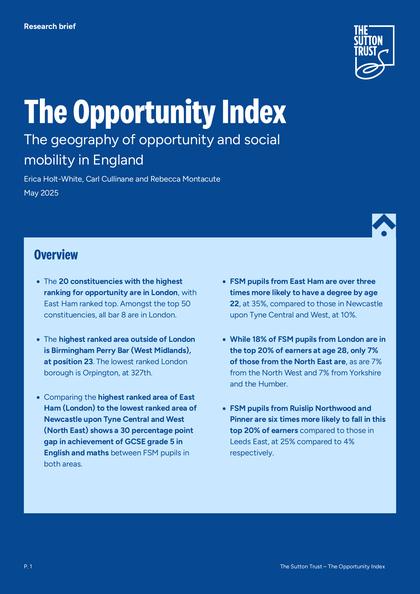
In this report, we provide the most detailed ever look at the geography of opportunity and social mobility in England. We closely examine how socio-economic background, geography and opportunity interact, with data looking at both parliamentary constituency and regional level in England. From educational attainment, to opportunities in higher education and employment, the research compares the outcomes of young people across the country, with a particular focus on the chances of social mobility for young people from lower income homes. Alongside the brief, there is an interactive map which can be accessed at: https://www.suttontrust.com/opportunity-indexinteractive-map
Centre for Young Lives – Ambitious for Young People

The Centre for Young Lives outlines a vision for transforming youth provision in the UK, emphasizing safe spaces, engaging activities, and trusted adult relationships. The proposed Young Futures programme includes 1,000 youth centres, year-round activities, and 10,000 trained youth practitioners. This investment, costing £1.46 billion over three years, aims to address challenges like youth crime, mental health crises, and educational disparities. Alma Economics estimates a £2.40 return for every £1 invested, with benefits in education, mental health, and crime reduction. The report calls for sustainable funding and a coordinated national strategy to ensure equitable opportunities for all young people.
UK Youth – In our own words
Research exploring the needs and preferences of young people and youth practitioners in England
National Citizen’s Service (NCS) want to understand the latest perceptions, needs and preferences of young people and youth practitioners across England, in relation to youth provision. In January 2024, NCS commissioned UK Youth to undertake qualitative research to explore this topic. Insights were gathered through mixed methods, with a strong focus on an innovative approach to soliciting and analysing audio-recorded testimonies.
National Youth Agency Strategy 2024-29 – Enabling great youth work to happen
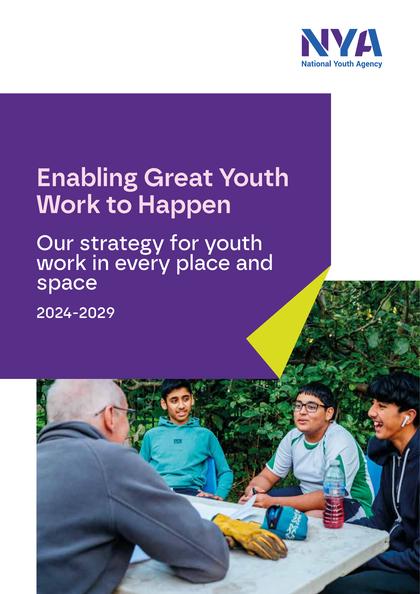
As the national body for youth work in England, the National Youth Agency exists to champion the value of youth work for young people, for local communities and for society. We work in partnership and believe in collaborative leadership, listening to youth workers and the youth work sector so that we can understand their needs and respond to the challenges they face. We are ambitious for youth work and for young people and integrate youth voice and influence across our work.
Youth Work Matters – youth provision and life outcomes – a systemic literature review
A Youth Evidence Base report by SQW and the University of Warwick for the Department for Culture, Media and Sport.
This review located and screened over 25,000 studies from across 22 major research databases and repositories. A total of 77 studies met the review criteria for relevance and suitability. Studies were quality assessed, organised within six activity areas, and analysed in-depth by area to better understand the impacts of open access youth activities
Youth Work Matters – youth provision and life outcomes – a study of longitudinal research
A Youth Evidence Base report for the Department for Culture, Media and Sport
Our research used five datasets to explore the effects of weekly participation in youth clubs on outcomes later in life. Four of the five datasets were longitudinal studies; the fifth was a rolling annual survey. The studies covered different generations of young people from the 1970s to 2000s, and the timing of outcome measurements reflected this.
Youth Work Matters – youth provision and life outcomes
A Youth Evidence Base report studying the local impact of youth clubs.
The goal of this research was to understand what impact the presence of youth clubs have on local areas. Data sources were predominantly official statistics relating to national and local government. Some data were unavailable for all areas of interest, or were reported inconsistently across different local authorities. We encountered data shortages relating to the numbers of youth clubs, and youth workforce headcount including volunteers, and participants. Interviewees said that the trends revealed in our analysis nevertheless broadly reflected their experiences.
#Untapped: The economic value of youth work
Youth work can transform lives. It provides a safe place for young people to find their place in society and learn practical skills to help them realise their full potential. In these difficult times, this is more important than ever. New research by UK Youth and economics consultancy, Frontier Economics, has found that annual investment in youth work saves the government as much as £3.2 billion.